The Future is ****** Comic CTF - Kickstarter
URL: https://x.com/BHinfoSecurity/status/1765837749611905455/photo/1
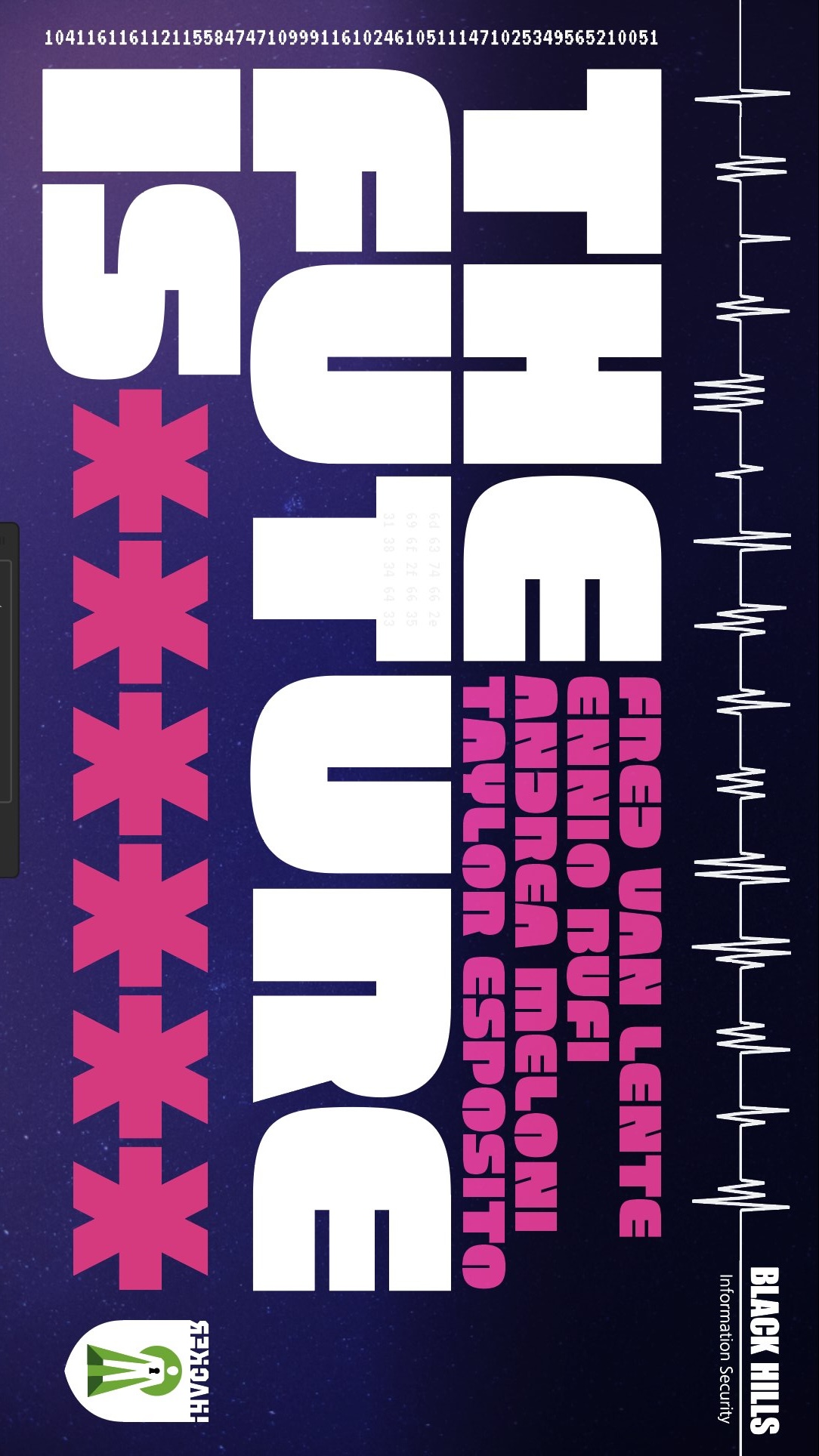 At the top of the image, we can see decimal numbers that can be translated to their ASCII representations. We can just put this into CyberChef, Python or whatever you like, e.g.
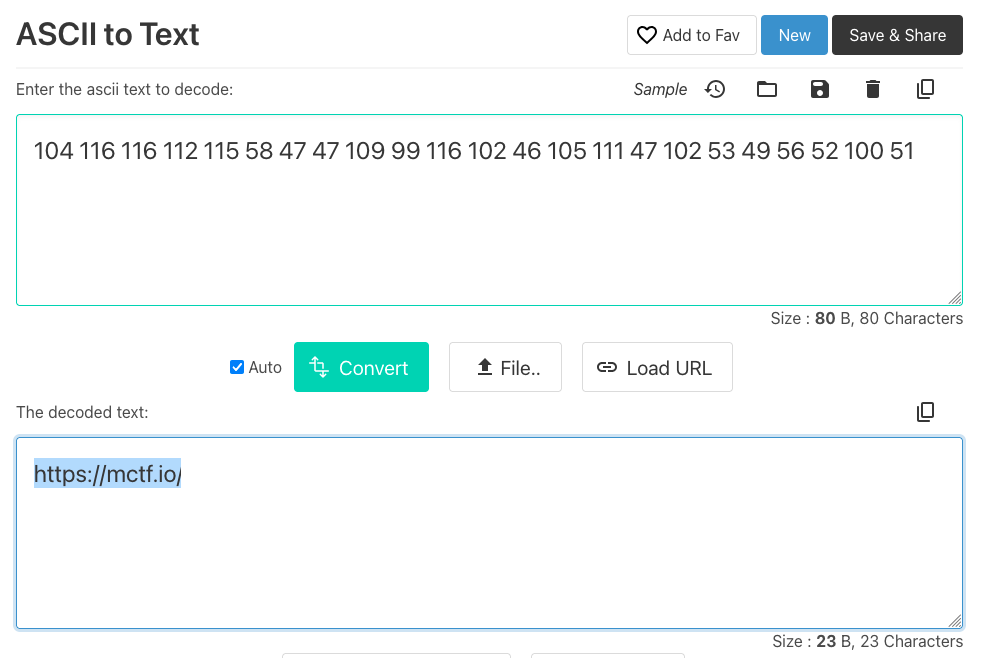
And now we get a URL that points to the MetaCTF platform.
Kickstarter Hints
Congratulations! You solved the first puzzle. There will be many more...
See below for Kickstarter Challenge Hints.
All the challenges and puzzles will come with points. Some will be listed and some you'll have to find. Submit the flags you find here.
The flag for this puzzle is KEY{REDACTED}. From the "Problems" page, submit this flag as a "Bonus".
If you have any questions, feel free to ask in the #tfi-ctf-chat channel of our Discord server: https://discord.gg/rekcah.
- How do websites know what browser you're using?
- Learn about crib dragging
- Check out list comprehension.
- Why are you told not to open email attachments?
From the Kickstarter page we get some small challenges.
Challenge #1 of 4:
We are given the following binary blocks:
01101000 01110100 01110100 01110000 01110011 00111010 00101111 00101111 01101101 01100011 01110100 01100110 00101110 01101001 01101111 00101111 ******** ******** ******** ******** ******** ******** ********
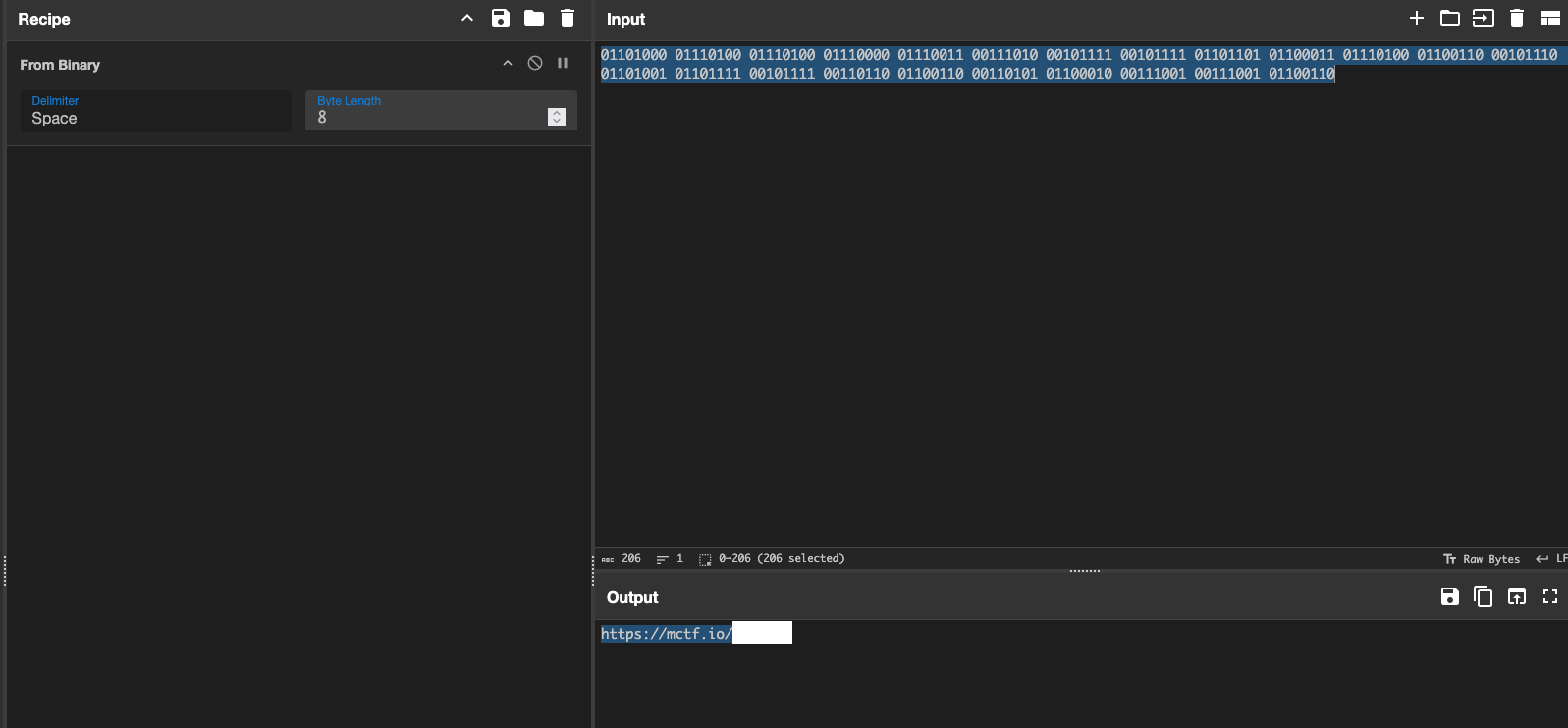
This can simply be translated with CyberChef to a valid URL https://mctf.io/REDACTED, which gives us the actual challenge.
Kickstarter Challenge #1
Congratulations! You found a Kickstarter Challenge!
Here's a small bonus for finding it: KEY{REDACTED}. Submit it as a "Bonus" here.
Solve the challenge below for additional points. The flag will be in format KEY{...}:
The comic is set in the future... can you prove to us that you belong here?
Access the challenge here. https://challenges2.tficomic.io/kickstarter-1/
Solution
So we basically get a URL. If we use that link, it will tell us that only the Chrome browser in a certain version is accepted. I personally wouldn't recommend Chrome anyway, but fair enough...

Okay, every device can state which user agent is used, so that the web server knows what should be delivered. There are multiple ways to set this manually. You can use your browser and manipulate the HTTP GET request with the desired UA, you can intercept the request and change it, etc.
The easiest way, in my opinion, is to set the UA with cURL. You can do it the following way:
curl -A "Chrome/476" https://challenges2.tficomic.io/kickstarter-1/
This will return the following response:
<!DOCTYPE html>

<html style="height:100%" lang="en">

<head>

  <link rel="stylesheet" href="https://cdnjs.cloudflare.com/ajax/libs/bootswatch/5.3.0/darkly/bootstrap.min.css" />

  <link rel="stylesheet" href="https://cdnjs.cloudflare.com/ajax/libs/font-awesome/6.5.1/css/all.min.css" />

  <meta name="viewport" content="width=device-width, initial-scale=1">

<meta name="robots" content="noindex, nofollow">

  <title>Future</title>

</head>


<body style="height:100%;background-color:#17082e !important;background-image: none;">


  <div class="container py-5">

    <div class="row">

      <div class="col-md-8 offset-md-2 mt-2 text-center">

        <div class="border-light border border-1 py-3 ">

            <!-- <h4>Kickstarter Challenge #1</h4> -->

            <p class="card-text">If you access this page using Chrome browser version 476, we'll give you the flag!</p>

            <p class="card-text">Congrats! Flag: <code>KEY{*******}</code></p>

        </div>

      </div>

    </div>

  </div>

  <script src="https://cdnjs.cloudflare.com/ajax/libs/jquery/3.6.0/jquery.min.js"></script>

  <script src="https://cdnjs.cloudflare.com/ajax/libs/twitter-bootstrap/5.3.0/js/bootstrap.bundle.min.js"></script>

  <script src="https://cdnjs.cloudflare.com/ajax/libs/font-awesome/6.5.1/js/all.min.js"></script>

</body>

</html>

Yielding: KEY{REDACTED}
Kickstarter Challenge #2 of 4
The second Kickstarter challenge from the same site gives us a Base64-encoded string:
QUJBQkIgQUFBQkEgQkFBQkEgQUFCQUIgLiBBQkFBQSBBQkJBQiAv****************
We can decode that in a shell in the following way:
echo "QUJBQkIgQUFBQkEgQkFBQkEgQUFCQUIgLiBBQkFBQSBBQkJBQiAv****************" | base64 -d
ABABB AAABA BAABA AABAB . ABAAA ABBAB / *******
Well, if you have never seen such a string, you can simply analyse it with certain tools or websites. However, this is a Bacon cipher - a classic cipher from the 17th century, named after Francis Bacon. We can plug this ciphertext into a tool of our choice, e.g. dCode.
Decrypting the string ABABB AAABA BAABA AABAB . ABAAA ABBAB / *******, we can already see that the pattern seems to be a URL - the tficomic.io schema of nearly all URLs in this CTF. So we can mount a known-plaintext attack against this ciphertext, as we know some partial plaintext elements.
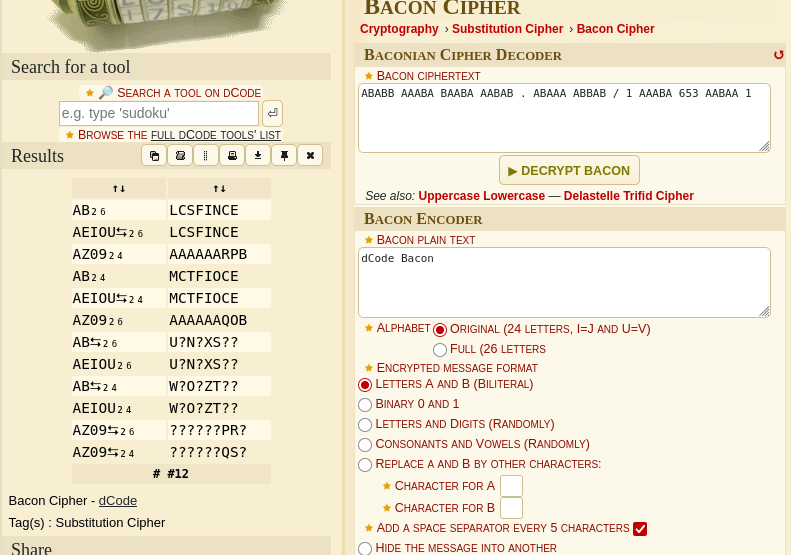
With this we can get a mapping that maps \(AAABA \to C\) and \(AABAA \to E\), resulting in the challenge URL: https://tficomic.io/*, where the actual challenge begins.
Kickstarter Challenge #2
Congratulations! You found a Kickstarter Challenge!
Here's a small bonus for finding it: KEY{REDACTED}. Submit it as a "Bonus" here.
Solve the challenge below for additional points. The flag will be in format KEY{...}:
We received 3 encrypted messages, but we know that all of them have been encrypted with the same XOR key and that one of them is the flag in format KEY{...}. Here are the messages:
9d c2 d3 86 cf ee 9c 9f 68 d1 62
95 e8 e7 94 9e f7 bf c0 62 dc 6c
9d d4 dc 8a de bd bb 93 72 c8 74
Can you decrypt them?
Solution
Via CyberChef, we can use the following recipe: From Hex and XOR. We know that the correct key starts with the letters KEY{ and ends with }. Additionally, we can see that the first and last messages start with \(9d\), the middle one with \(95\). A valid hypothesis would be that the second message is the flag/key.
As we don't know anything about the key itself but have a hypothesis about what the middle plaintext probably looks like, we can do a known-plaintext attack.
Side note on cryptanalysis:
\(M\) is the message text (or plaintext), \(K\) is the cipher key and \(C\) is the encrypted text or ciphertext. \(XOR\) or \(\oplus\) is the exclusive \(OR\) operation that is used. Then we can write:
and
As this is a symmetric encryption scheme, \(K\) is used in both directions. Additionally, the \(\oplus\) operator is its own inverse, meaning if you apply it twice with the same value you land back at the starting point. Furthermore, it's commutative, meaning the ordering is irrelevant. This leads to the best part: you can swap around ciphertext and plaintext in a way that allows us to derive the key (or to nullify the key) if we have (partial) knowledge about ciphertext and plaintext. Note: That's why a key must never be reused for multiple messages. A One-Time-Pad is only secure if the key is truly random, at least as long as the message and used only once.
Meaning if we combine (a part of) the known plaintext with the ciphertext, this will yield the key.
Let's try this approach:
Translating KEY{ to hex: 4b 45 59 7b
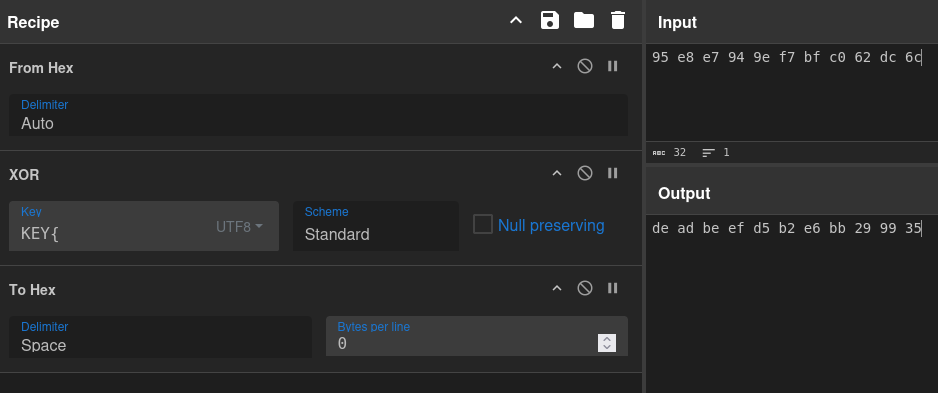
Well, this seems to be valid, as deadbeef is common hexspeak and supports our hypothesis. But these are only four bytes of our eleven-byte ciphertext.
A first hypothesis could be that the key just wraps around and repeats itself - but this does not work. A second guess would be that, as the first part was hexspeak, maybe the second part is as well. Trying a few of the common hexspeak strings gives us no result.
The best approach is to apply cryptanalysis to the other two messages. As all messages use the same key, we can check whether the first four bytes of their plaintexts are useful. If the messages are human-readable words, we can maybe guess the rest of the plaintext and therefore directly derive the key.
Let's try the first message:
Which in UTF-8 translates to: Comi
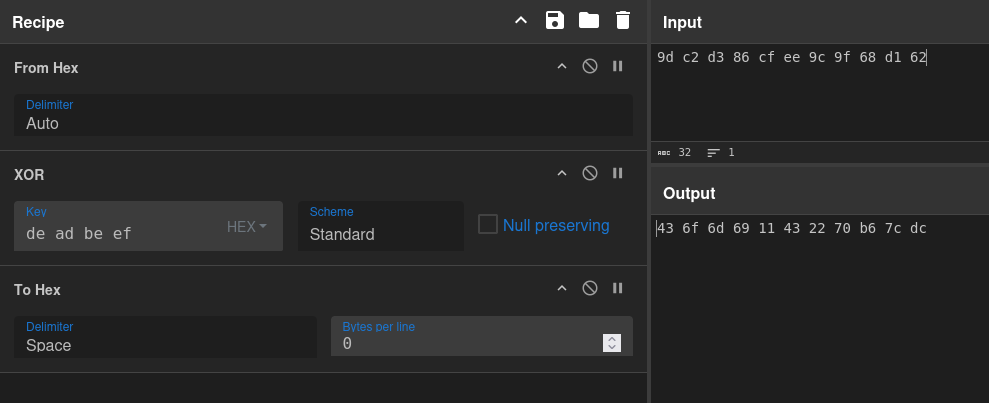
Okay, now we can try some words on the key. The same holds true for the third message, which yields the first part of Cybe[...].
Completing these words gives us the same key \(K\) for the two plaintext messages (redacted here). Well, I gave up on the first message, as the space between the words and the capital letter weren't that obvious to me. Of course, if we wrote a script that ensures the messages belong to valid English words, it would be easier (I will provide a script later). The third message was more obvious. The derived key is de ad be ef ** ** ** ** ** ** **
With this key the second message uncovers: KEY{REDACTED}
Side note: Before thinking about the other two messages and a known-plaintext attack, I tried the first part of the key and started some brute-forcing - even given that the inner parts of the flag are random hex symbols (which drastically shrinks the space of possible messages), this is not feasible. I spent 2-3 hours until I thought about the two other messages and that they use the same key. Well...
Challenge #4 of 4
** ** *** *** ** ** ** 74 89 811 64 511 301 211 221 74 74 85 201 99 301 301 711
Reversing this list gives us a mapping from decimals to ASCII symbols, but in the wrong order.
** ** *** *** ** ** ** 47 98 118 46 115 103 112 122 47 47 58 102 99 103 103 117
117 103 103 99 102 58 47 47 122 112 103 115 46 118 98 47 ** ** ** *** *** ** **
Which translates to: uggcf://zpgs.vb/* As we can already deduce, the URL normally starts with tficomic.io/ or mctf.io/ - so this is maybe encrypted.
It turns out that this is ROT13 encoded:
https://mctf.io/REDACTED
Kickstarter Challenge #4
Congratulations! You found a Kickstarter Challenge!
Here's a small bonus for finding it: KEY{REDACTED}. Submit it as a "Bonus" here.
Solve the challenge below for additional points. The flag will be in format KEY{...}:
Our security team intercepted a suspicious email.
Can you take a look and see why it might have gotten flagged?
The email contains a .doc attachment, which we can extract using a shell or CyberChef. The last part of the file is the Base64-encoded attachment:
UEsDBBQABgAIAAAAIQB+OOx6hwEAAK0FAAATAAgCW0NvbnRlbnRfVHlwZXNdLnhtbCCiBAIooAAC
AAAAAAAAAAAAAAAAAAAAAAAAAAAAAAAAAAAAAAAAAAAAAAAAAAAAAAAAAAAAAAAAAAAAAAAAAAAA
AAAAAAAAAAAAAAAAAAAAAAAAAAAAAAAAAAAAAAAAAAAAAAAAAAAAAAAAAAAAAAAAAAAAAAAAAAAA
AAAAAAAAAAAAAAAAAAAAAAAAAAAAAAAAAAAAAAAAAAAAAAAAAAAAAAAAAAAAAAAAAAAAAAAAAAAA
AAAAAAAAAAAAAAAAAAAAAAAAAAAAAAAAAAAAAAAAAAAAAAAAAAAAAAAAAAAAAAAAAAAAAAAAAAAA
AAAAAAAAAAAAAAAAAAAAAAAAAAAAAAAAAAAAAAAAAAAAAAAAAAAAAAAAAAAAAAAAAAAAAAAAAAAA
AAAAAAAAAAAAAAAAAAAAAAAAAAAAAAAAAAAAAAAAAAAAAAAAAAAAAAAAAAAAAAAAAAAAAAAAAAAA
AAAAAAAAAAAAAAAAAAAAAAAAAAAAAAAAAAAAAAAAAAAAAAAAAAAAAAAAAAAAAAAAAAAAAAAAAAAA
AAAAAAAAAAAAAAAAAAAAAAAAAAAAAAAAAAAAAAAAAAAAAAAAAAAAAAAAAAAAAAAAAAAAAAAAAAAA
AAAAAAAAAAAAAAAAAAAAAAAAAAAAAAAAAAAAAAAAAAAAAAAAAAAAAAAAAAAAAAAAAAAAAAAAAAC0
lM9OwkAQxu8mvkOzV9MueDDGUDgIHpVEfIBhO4XVdnezO/x7e6e0EDVAVfRCUma+3/fNdju9wbos
oiX6oK1JRTfpiAiNspk2s1S8TB7iWxEFApNBYQ2mYoNBDPqXF73JxmGIWG1CKuZE7k7KoOZYQkis
Q8OV3PoSiB/9TDpQbzBDed3p3EhlDaGhmCqG6PeGmMOioGi05r/rJFNtRHRf91VWqQDnCq2AuCyX
JkvKENs81wqT5RTG3r6iIiEPwjwWoYX2OXLcxE1Yue0Jc+3CFTcccagqxw0a3ROfs9cZRmPw9Agl
d8mV9ZnMrFqUrExOY5qpK0myl5SgvB0ZmBbIVdBml/KoGx/XEAh+YNYoWsmBNgWGb4C/nHb9Hvcj
VSznrcIQ+BqWRVJz2+2RiAX/EaAht0ZY4fT531J8gLcGydl3Ul2Kv4+xR7eGIF4HWP92z86xxZyy
5E5eAy7wevG/GHv3yVfqmAd26EmfvnV7R0afPR9W2yTD7IC33C7b/jsAAAD//wMAUEsDBBQABgAI
Solution
Running strings on this document returns nothing that looks like our flag format. In another comic there is pretty much the same challenge, but there one was able to find the flag directly via strings. Maybe looking into this document will help. As this is a valid Office document, maybe the VBA macros are hidden somewhere in it. Opening the file with an office tool like LibreOffice, under Tools \(\to\) Macros \(\to\) Edit Macros, we can view the macros of this file.
After looking through the macros, we find the following:
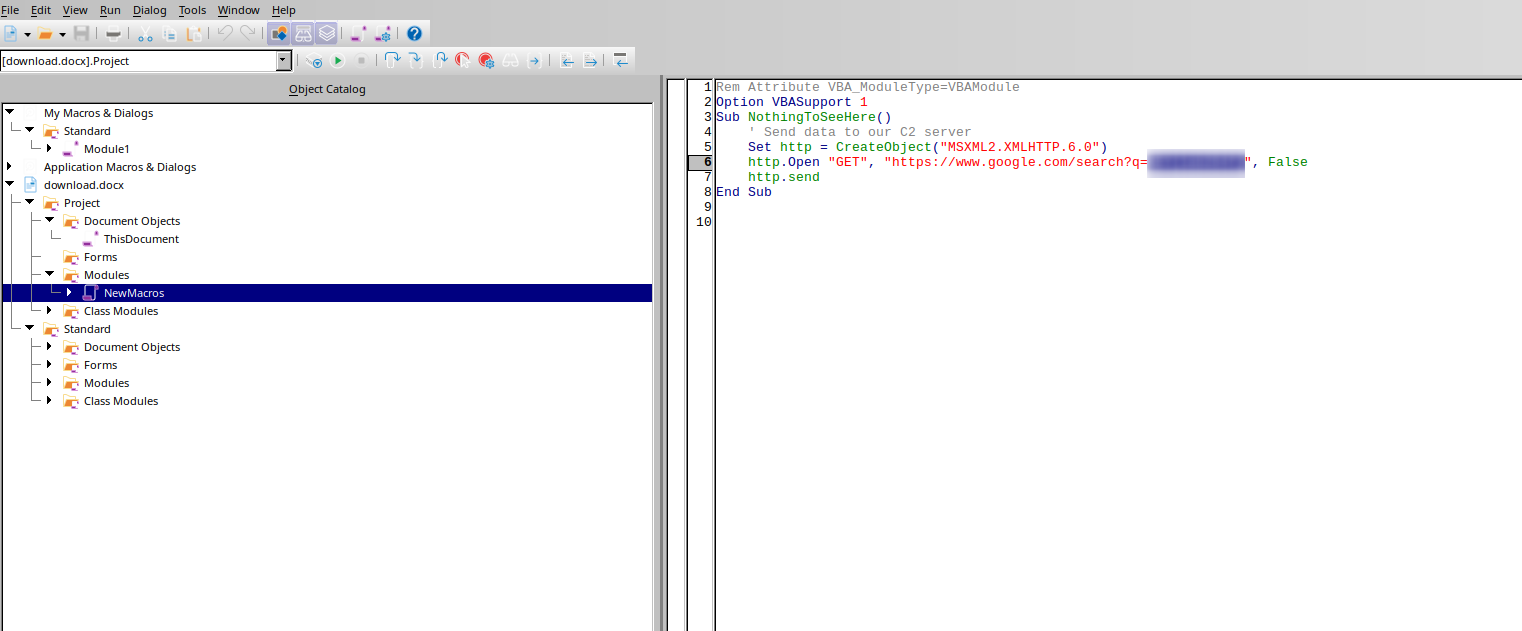
Well, this macro contains our flag.
ASHCAN
This challenge can be found here
Hey there. Are you trying to crack the cover password?
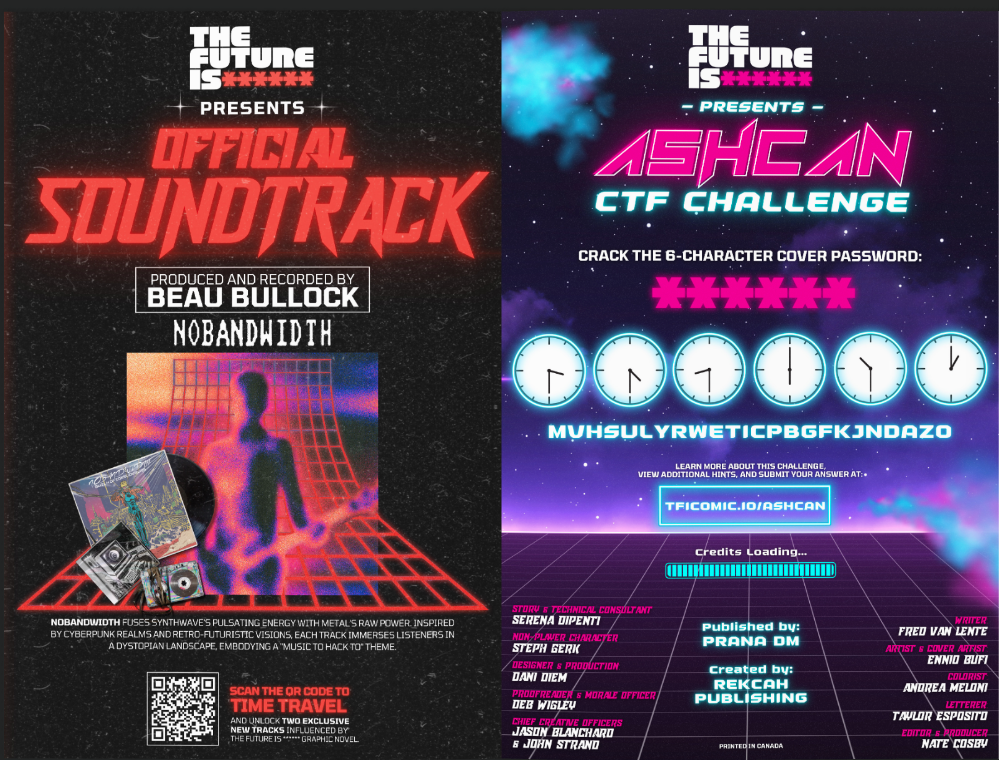
You've been given a list of letters and 6 images of clocks.
How many letters are in the list?
Looks like the minute hand only shows \(:00\) or \(:30\) minutes in all the images. How many possible clock positions are there if you are limited to 30 minute increments?
Once you crack the cover password, you can submit the answer to the ASHCAN - Crack the ****** challenge in this platform.
Solution
By going in half-hour steps (30 min.), we have a set of 24 steps - as many letters as our encoding alphabet. We need to translate the clocks into these steps. Meaning: \(00:00 \mapsto M\) \(00:30 \mapsto U\) etc.
That means 03:30 is \(1+ 3 \cdot 2 + 1 = 8\) (the first one comes from the starting point at zero). \(8 \mapsto *\) So the eighth letter. 04:30 is the 10th \(\mapsto *\). \(08:30 = 18\), mapping to * \(06:00 = 13\), mapping to * \(10:30 = 22\), mapping to * \(01:00 = 3\), mapping to * Giving us: REDACTED
Kickstarter Campaign 2
Challenge 1 of 4:
ROT13 GSVPBZVP.VB/**
Using the hinted ROT13 decoding: TFICOMIC.IO/REDACTED
Kickstarter 2 - Cipher 1
Congratulations! You found a Kickstarter bonus flag!
Submit KEY{REDACTED} as a "Bonus" flag in the CTF platform. Sign up here.
Challenge 2 of 4:
HEX 5A2D3E4120677572786C6E72782E726C2F****************0D0A
Solution
Translating this from hex to ASCII results in:
Z->A gurxlnrx.rl/********
The hint tells us that the mapping is \(Z \to A\) - this could mean we have to shift the letters with the mod operator or that the alphabet is in reverse order. The best way to approach this is to think about where we want to go. We know, first, that this looks like a URL format and, second, if this hypothesis is true, the URL has to look like tficomic.io.
With this in mind: \(t\) is the \(20\)th letter, or the \(7\)th counting from the end. As indicated, it is reverse ordering, meaning in reverse order \(t = 7\) and in ordinary order \(7 \to g\), so that \(t \to g\): the seventh letter is \(g\), which confirms the assumption. For ease, we can use the following mapping table:
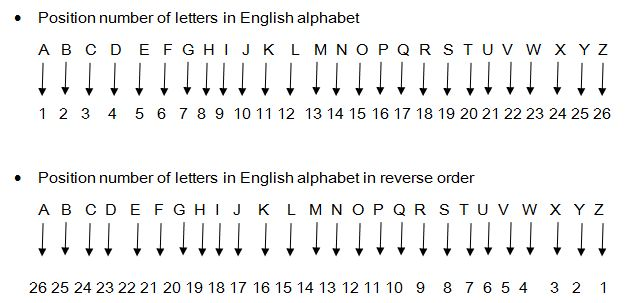
Okay: ******** can therefore be translated to:
Each letter maps to its counterpart in the table (the result is redacted here).
Numbers weren't decoded.
tficomic.io/REDACTED \(\to\) https://challenges.tficomic.io/SOMETHING/
Which is correct! And we land on the actual challenge.
Side note: This challenge can be used for the cover challenge of TFI 6.
Kickstarter 2 - Cipher 2
Congratulations! You found a Kickstarter bonus flag!
Submit KEY{REDACTED} as a "Bonus" flag in the CTF platform. Sign up here.
Challenge 3 of 4:
BASE? ORTGSY3PNVUWGLTJN4X*************
As no base is given, we can either iterate over all possible bases or simply try the common ones, e.g. Base64 or Base32.
Trying Base32, the string decodes to:
echo "ORTGSY3PNVUWGLTJN4X*************" | base32 -d
tficomic.io/REDACTED
Problem: Kickstarter 2 - Cipher 3 (+ Challenge)
Congratulations! You found a Kickstarter Challenge!
Here's a small bonus for finding it: KEY{REDACTED}. Submit it as a "Bonus" here.
Solve the challenge below for additional points. The flag will be in format KEY{...}:
Take a look at this Python authentication function. Can you figure out the correct password and find the flag?
Solution
The Python code in question:
# The Future Is ****** – Terminal Access Panel

def check(pwd):
    secret = [88, 74, ***, ***, ***, ***, 110, 114, 76, ***, ***, ***, ***]
    entered = [ord(c) ^ 0x13 for c in pwd[::2]] + [ord(c) ^ 0x37 for c in pwd[1::2]]
    return secret == entered

user_input = input("Enter the access code: ").strip()
if check(user_input):
    print("Access granted!")
    print("Flag:", user_input)
else:
    print("Access denied. Terminal locked.")
The important part is [ord(c) ^ 0x13 for c in pwd[::2]] + [ord(c) ^ 0x37 for c in pwd[1::2]], which takes the entered password and does an XOR operation with two different integer values, depending on whether the index of the char position is odd or even. XOR is its own inverse: \(KEY \oplus KEY = 0\) and \(MESSAGE \oplus 0 = MESSAGE\). Therefore, \(MESSAGE \oplus KEY = CIPHER\) leads to the following: \(CIPHER \oplus KEY = MESSAGE \oplus KEY \oplus KEY = MESSAGE\).
This leads to:
88 ^0x13 =  75  K
74 ^0x13 =  89  Y
*** ^0x13 = *** *
*** ^0x13 = *** *
*** ^0x13 = *** *
*** ^0x13 = *** *
110 ^0x13 = 125 }
for the even-indexed part and:
114 ^0x37 =  69  E
76 ^0x37 =  123 {
*** ^0x37 = *** *
*** ^0x37 = *** *
*** ^0x37 = *** *
*** ^0x37 = *** *
K*****}
E*****
KEY{REDACTED}
Challenge 4 of 4:
XOR 7A AC 67 A9 61A767A920A361E5****************
With a key size of 2 bytes, we can use a partial brute-force or something a little bit smarter... As we know the message has to start with tficomic.io, we can use this to invert the XOR operation.
With this knowledge: \(0x7A \oplus K_0 = t\) and \(0xAC \oplus K_1 = f\) As \(\oplus\) is reversible, we can solve this the other way around: \(0x7A \oplus 74 = 0E\) where 66 is \(f\) in ASCII hex, \(0xAC \oplus 66 = CA\).
By guessing that this is already the correct key length, we can try what happens if we calculate: \(67 \oplus 0E = 69\) which is ASCII for \(i\) which seems correct. So then \(A9 \oplus CA = 63\) which is \(c\).
So the key is two bytes long and therefore: RE DA.
Plugging this into CyberChef:
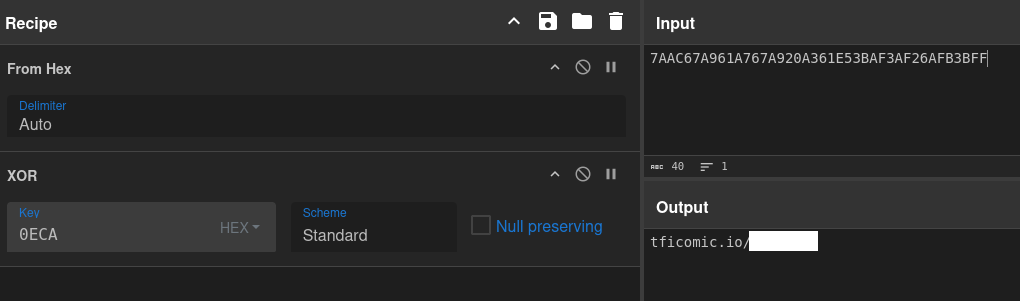
We get the URL: tficomic.io/REDACTED
Kickstarter 2 - Cipher 4 (+ Challenge)
Congratulations! You found a Kickstarter Challenge!
Here's a small bonus for finding it: KEY{REDACTED}. Submit it as a "Bonus" here.
Solve the challenge below for additional points. The flag will be in format KEY{...}:
We obtained a network capture of someone downloading a zip file with the flag inside. Can you analyse it and find the flag? The zip file password was on the website from which the file was downloaded.
Solution
We can put the pcap file into Wireshark and follow the HTTP stream to see if and where 'flag.zip' is downloaded. By doing so, we see that this happens in TCP stream 4. We can obtain the file by exporting it from the capture: File \(\to\) Export Objects \(\to\) ...HTTP.
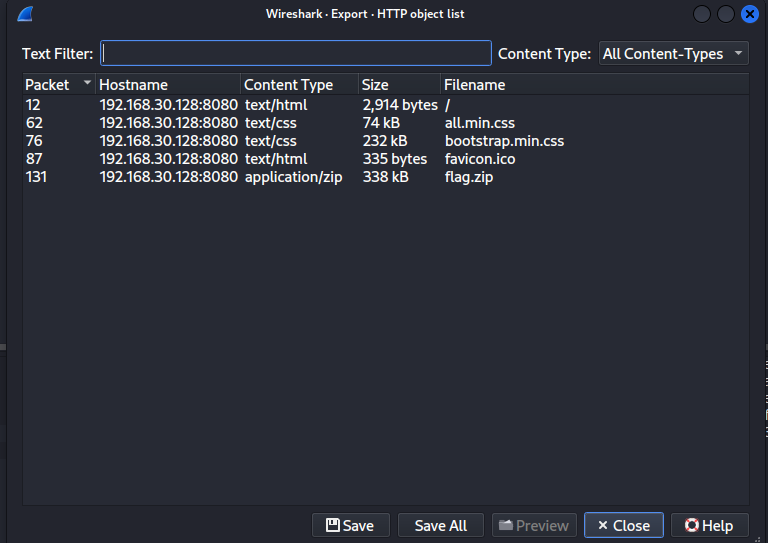
Now that we have the ZIP file, we need to obtain the password for this archive. The problem states that the password is in the web code. We can either search for it or download the HTML code and have a direct look at the page. Both will work.

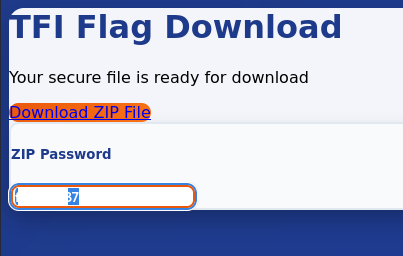
The password is REDACTED, which allows us to open the archive with this picture:
This yields the flag: KEY{REDACTED}